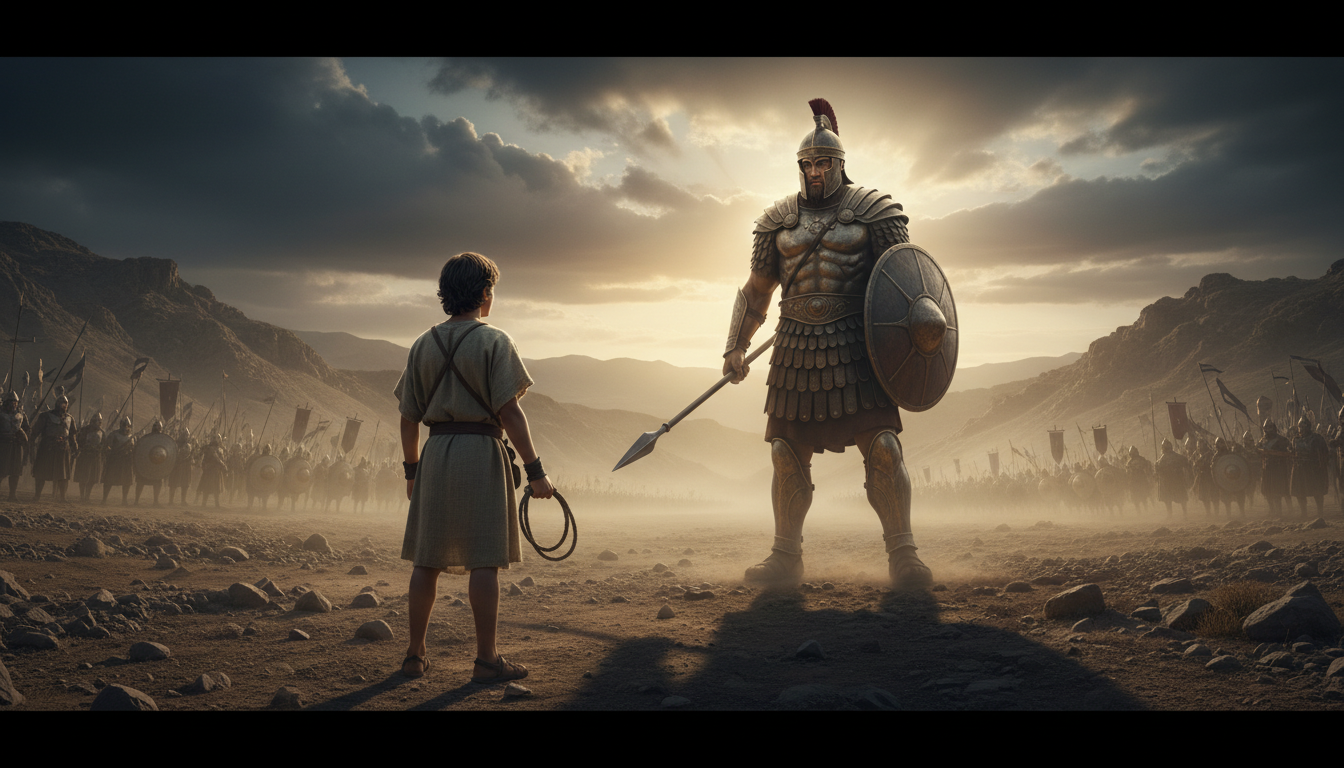
A young shepherd walked toward a heavily armed giant with only a sling, five smooth stones, and confidence in the living God. The story of David and Goliath in 1 Samuel 17 is one of the Bible’s best-known accounts of courage—but its message reaches beyond the familiar idea of overcoming impossible odds.
The Philistine Challenge in the Valley of Elah
Israel and the Philistines gathered on opposing hillsides, with the Valley of Elah between them (1 Samuel 17:1–3). A Philistine champion named Goliath came forward from Gath. Scripture describes his impressive height, bronze armor, heavy spear, and intimidating presence (1 Samuel 17:4–7). Ancient textual traditions differ on the precise number given for his height, but all portray him as a formidable warrior.
For forty days Goliath challenged Israel to send a man to fight him in single combat. Saul and the Israelite army were afraid (1 Samuel 17:8–11, 16). The confrontation became more than a military standoff: Goliath openly defied the armies of Israel.
Why Was David at the Battlefield?
David was the youngest son of Jesse. While his three eldest brothers served with Saul’s army, David tended his father’s sheep. Jesse sent him to bring food to his brothers and check on their welfare (1 Samuel 17:12–20).
When David arrived, he heard Goliath’s challenge and saw Israel’s fear. He asked why this Philistine should be allowed to defy the armies of the living God (1 Samuel 17:23–26). David’s eldest brother Eliab rebuked him, but David continued asking questions until his words reached King Saul.
David’s Confidence Came From God’s Faithfulness
Saul doubted that a young man could defeat an experienced warrior. David explained that, while caring for sheep, he had confronted a lion and a bear to protect the flock. He believed the Lord who had delivered him before could deliver him again (1 Samuel 17:32–37).
Saul offered David his armor. David tried it but declined because he was not accustomed to it. Instead, he took his staff, selected five smooth stones from the brook, placed them in his shepherd’s pouch, and approached Goliath with his sling (1 Samuel 17:38–40).
David and Goliath: The Battle
Goliath looked at David with contempt and cursed him by his gods. David answered that Goliath came with sword, spear, and javelin, but David came in the name of the Lord of hosts, the God of Israel’s armies (1 Samuel 17:41–47).
David declared that the battle belonged to the Lord. As Goliath advanced, David ran toward the battle line, took a stone from his bag, and slung it. The stone struck Goliath in the forehead, and the giant fell face down (1 Samuel 17:48–49).
According to 1 Samuel 17:50–51, David prevailed with the sling and stone, then used Goliath’s own sword to finish the victory. When the Philistines saw their champion defeated, they fled, and Israel pursued them (1 Samuel 17:51–53).
Why Did David Choose Five Smooth Stones?
The text says David chose five smooth stones from the brook (1 Samuel 17:40), but it does not explain why he selected exactly five. Some later teachings assign symbolic meanings to the stones or connect them to other giants. Those ideas may be used as illustrations, but they are interpretations, not explanations explicitly supplied by 1 Samuel 17.
The narrative’s emphasis is on David’s trust in God and his readiness to act—not on a hidden meaning behind the number of stones.
Five Lessons From David and Goliath
- Faith remembers God’s past faithfulness. David drew courage from the Lord’s help during earlier dangers (1 Samuel 17:34–37).
- Outward appearance is not the whole story. The intimidating champion was not beyond God’s power (1 Samuel 17:4–11, 45–47).
- Courage still requires action. David prepared, approached the battle, and used the skill he had developed as a shepherd (1 Samuel 17:40, 48–49).
- Do not confuse someone else’s equipment with your calling. David declined armor he could not use effectively and went forward with familiar tools (1 Samuel 17:38–40).
- Give God the glory. David’s stated purpose was that people would know the Lord saves, and that the battle belongs to him (1 Samuel 17:46–47).
What Does David and Goliath Mean for Christians Today?
David’s story should not be reduced to a guarantee that every personal challenge will end in visible triumph. In its biblical setting, the account centers on God’s honor, Israel’s deliverance, and David’s trust. Christians can draw encouragement to face difficult responsibilities with faith, preparation, and humility, without assuming that God promises identical outcomes in every situation.
Frequently Asked Questions
Where did David fight Goliath?
The battle took place in the Valley of Elah, where Israel and the Philistines were encamped on opposing hills (1 Samuel 17:1–3).
What weapon did David use?
David struck Goliath with a stone launched from a sling. After Goliath fell, David used the giant’s sword (1 Samuel 17:49–51).
How old was David when he defeated Goliath?
1 Samuel 17 portrays David as a young man but does not provide his exact age at the time of the battle.
Explore More Stories of Faith and Courage
Continue with Daniel in the Lions’ Den, The Fourth Man in the Fire, and Noah’s Ark and the Great Flood. Browse more stories on our Bible Stories page.
Primary Scripture: 1 Samuel 17. This article distinguishes details in the biblical text from later interpretation.