On a mountain in ancient Israel, one prophet stood before a king, hundreds of rival prophets, and a divided nation. Two altars were prepared. No human hand would light the sacrifice. The question was simple and decisive: which God would answer by fire? The confrontation on Mount Carmel in 1 Kings 18 remains one of Scripture’s most dramatic accounts of faith, prayer, and the call to worship the Lord alone.
Why Did Elijah Confront the Prophets of Baal?
During the reign of King Ahab, the worship of Baal had gained royal support in Israel. A severe drought gripped the land. Earlier, Elijah had announced that rain would not fall except at his word (1 Kings 17:1). In 1 Kings 18, God instructed Elijah to appear before Ahab because rain was coming (1 Kings 18:1).
Ahab accused Elijah of troubling Israel. Elijah replied that the real trouble came from Ahab’s rejection of the Lord’s commands and his following of the Baals (1 Kings 18:17–18). Elijah called for the people and the prophets of Baal to gather at Mount Carmel.
The Challenge on Mount Carmel
Elijah challenged the people to stop wavering between two allegiances: if the Lord is God, follow him; if Baal is god, follow him (1 Kings 18:21). The people initially gave no answer.
Elijah proposed a test. Two bulls would be prepared on separate altars, with wood beneath them, but neither sacrifice would be set on fire. The prophets of Baal would call on their god, and Elijah would call on the Lord. The God who answered by fire would be acknowledged as God (1 Kings 18:22–24).
The passage identifies 450 prophets of Baal for this contest. It also mentions 400 prophets of Asherah in Elijah’s earlier summons (1 Kings 18:19), but the subsequent contest specifically describes the prophets of Baal. Keeping that distinction matters when retelling the story.
Baal’s Prophets Cry Out—But No Fire Comes
The prophets of Baal prepared their bull and called on Baal from morning until noon. They leaped around the altar, but there was no voice and no answer (1 Kings 18:25–26). Elijah mocked their efforts, suggesting that perhaps their god was occupied, traveling, or asleep (1 Kings 18:27).
The prophets cried louder and cut themselves according to their custom. Their frenzy continued until the time of the evening offering. Yet the account repeats its devastating conclusion: no voice, no answer, and no response (1 Kings 18:28–29).
Elijah Repairs the Altar and Pours Water Over It
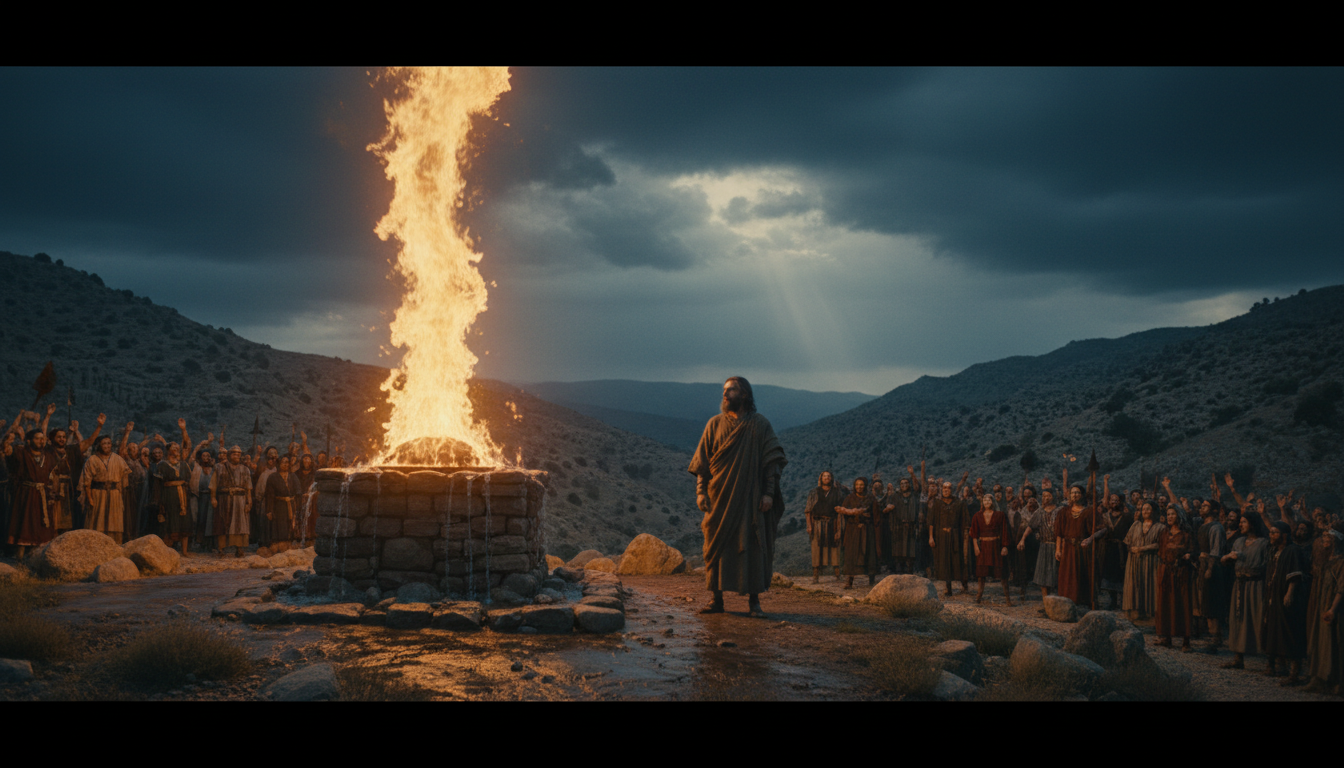
Elijah then called the people near. He repaired the broken-down altar of the Lord using twelve stones, corresponding to the tribes descended from Jacob. He arranged the wood, prepared the bull, and placed it on the altar (1 Kings 18:30–33).
Next came a striking instruction: pour water over the sacrifice and wood. Elijah had this done three times. Water ran around the altar and filled the trench (1 Kings 18:33–35). In the story, the soaked offering makes it unmistakable that the fire which follows is not an ordinary flame kindled by the people.
Elijah’s Prayer and Fire from Heaven
At the time of the evening offering, Elijah approached the altar and prayed to the Lord, the God of Abraham, Isaac, and Israel. He asked that the people would know the Lord is God and that Elijah had acted at God’s command. He also prayed that their hearts would be turned back (1 Kings 18:36–37).
Then the fire of the Lord fell. It consumed the burnt offering, the wood, the stones, and the dust, and it licked up the water in the trench (1 Kings 18:38). When the people saw it, they fell on their faces and acknowledged the Lord as God (1 Kings 18:39).
The narrative then reports Elijah’s command to seize the prophets of Baal and their execution at the Kishon brook (1 Kings 18:40). This is a description of an event within ancient Israel’s covenant setting, not a command for Christians to use violence against people of other beliefs today.
The Rain Returns After the Drought
After the confrontation, Elijah told Ahab that heavy rain was approaching. Elijah went to the top of Carmel and prayed while his servant looked toward the sea. Six times the servant saw nothing. On the seventh look, he reported a small cloud rising from the sea (1 Kings 18:41–44).
Soon the sky darkened, wind rose, and heavy rain fell (1 Kings 18:45). The chapter ends with a reminder that the God who answered by fire also controlled the rain that the land desperately needed.
Five Lessons From Elijah on Mount Carmel
- Choose whom you will worship. Elijah confronted divided loyalty and called Israel to follow the Lord (1 Kings 18:21).
- Prayer is about God’s glory, not performance. Elijah’s prayer was brief and focused on making God’s identity known (1 Kings 18:36–37).
- Obedience can require public courage. Elijah stood before a hostile king and a nation that had wandered from God’s commands (1 Kings 18:17–24).
- God’s power does not depend on human spectacle. The frantic efforts of Baal’s prophets contrasted with the Lord’s decisive answer (1 Kings 18:26–39).
- Persevere in prayer. Elijah continued praying and watching for rain even when the first reports showed no change (1 Kings 18:42–45).
What Does Elijah’s Fire from Heaven Mean for Christians?
The central message of 1 Kings 18 is that the Lord alone is God and worthy of Israel’s worship. The dramatic fire is not presented as a technique believers can reproduce on demand. Instead, the account calls readers to wholehearted faithfulness, prayer, humility, and recognition of God’s sovereignty.
James 5:17–18 later points to Elijah’s prayers in connection with the drought and returning rain, encouraging believers to take prayer seriously. The New Testament reference does not promise that every prayer will produce the same visible miracle.
Frequently Asked Questions About Elijah and Mount Carmel
Where did Elijah call down fire from heaven?
The confrontation took place on Mount Carmel, as recorded in 1 Kings 18:19–39.
How many prophets of Baal did Elijah confront?
1 Kings 18:22 specifies 450 prophets of Baal in the contest. The chapter also mentions 400 prophets of Asherah in the earlier gathering request (1 Kings 18:19).
Why did Elijah pour water on the altar?
Elijah ordered water poured over the sacrifice and wood three times (1 Kings 18:33–35). The narrative emphasizes that the altar was thoroughly wet before God answered by fire.
Did rain fall after the fire from heaven?
Yes. Following Elijah’s prayer and repeated watching, a small cloud appeared, and heavy rain followed (1 Kings 18:41–45).
Explore More Bible Stories
Discover more accounts of courage, judgment, and God’s faithfulness in David and Goliath, Daniel in the Lions’ Den, The Fourth Man in the Fire, and Noah’s Ark and the Great Flood. Visit our Bible Stories page for more.
Primary Scripture: 1 Kings 18. Historical narrative and present-day application are distinguished throughout.